Claude Fast Mode: Anthropic’s Bold 6x Price Premium for Speed
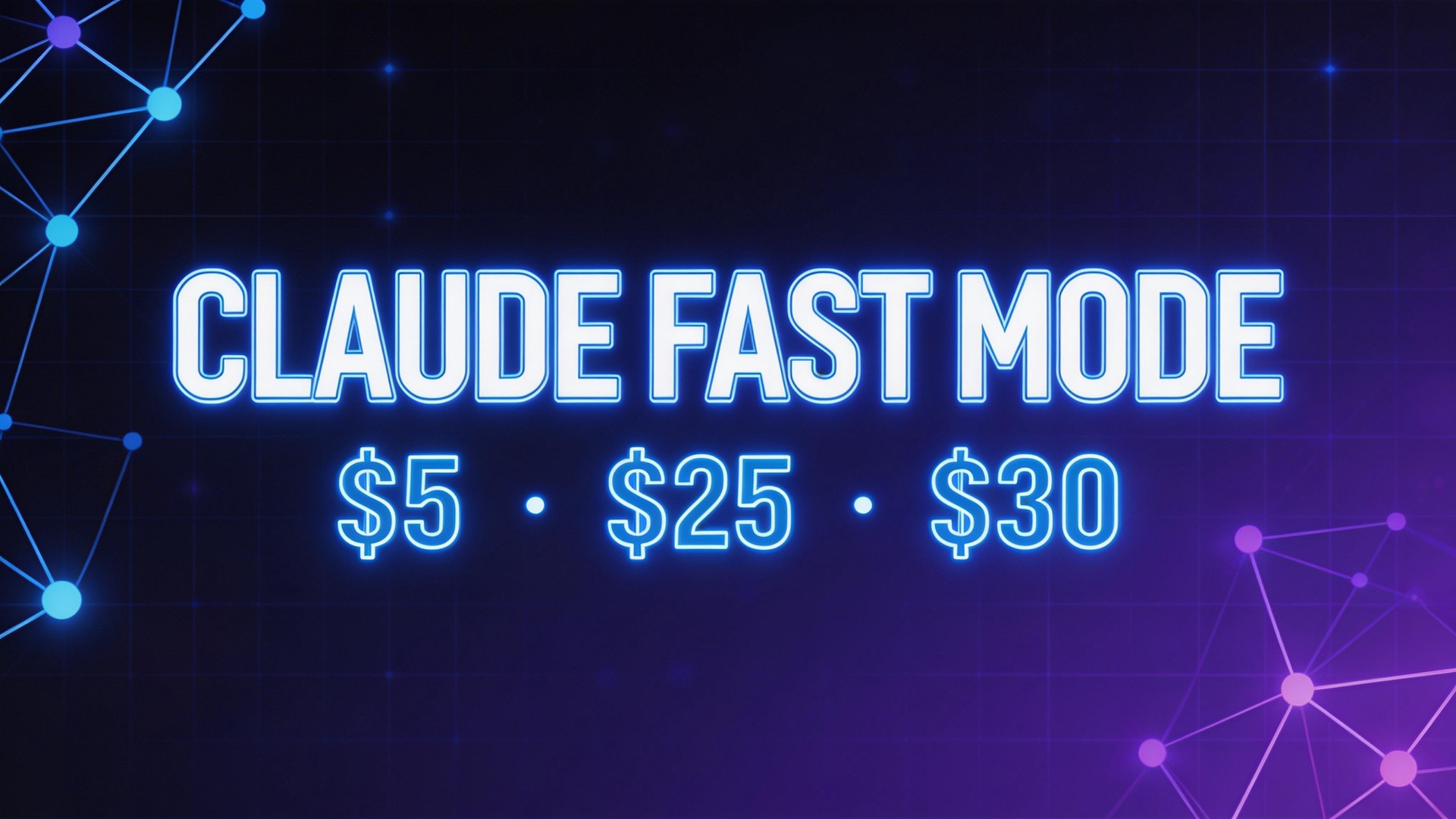
Anthropic just introduced a 2.5x faster version of Claude Opus 4.6. The catch? It costs six times more. This pricing experiment reveals something important about where AI capabilities are heading.
The Core Insight
Simon Willison flagged an interesting new feature in Claude Code: type /fast and you get access to a significantly faster version of Claude Opus 4.6. The speed improvement is substantial—Anthropic’s teams report 2.5x faster responses.
The pricing, however, is eye-opening:
Standard Opus 4.6:
– $5/million input tokens
– $25/million output tokens
Fast Mode (after Feb 16):
– $30/million input tokens
– $150/million output tokens
That’s a 6x multiplier on both input and output. During the promotional period through February 16th, prices are “only” 3x the standard rates.
If you’re using the expanded 1 million token context window (which already has a 2x input premium), fast mode costs:
– $60/million input tokens
– $225/million output tokens
Why This Matters
This pricing structure tells us several things about the AI market:
1. Latency is a premium feature.
For AI agents running in loops—making decisions, calling tools, iterating on results—response time directly impacts throughput. A 2.5x speed improvement can mean 2.5x more iterations per hour, which may be worth far more than 6x the cost for certain applications.
2. Anthropic is segmenting the market.
They’re creating explicit tiers: standard (good quality, reasonable price), fast (same quality, higher price, better latency), and the implicit economy tier (older models, lower prices). This mirrors how cloud compute has always worked.
3. Compute costs are real.
The price premium suggests fast mode requires significantly more infrastructure—possibly dedicated GPU allocation, optimized batching, or priority routing. Anthropic isn’t charging 6x just because they can; there are genuine cost differences.
The Numbers Game
Let’s do some back-of-envelope math. A typical Claude Code session might process:
– 50,000 input tokens (context, code files, conversation history)
– 10,000 output tokens (responses, code generation)
Standard pricing:
– Input: $0.25
– Output: $0.25
– Total: $0.50
Fast mode pricing (after promo):
– Input: $1.50
– Output: $1.50
– Total: $3.00
For a developer earning $100/hour, if fast mode saves 10 minutes per session by reducing wait time, the $2.50 premium is trivially worth it. At enterprise scale, with multiple developers and automated workflows, the math gets even more favorable.
Key Takeaways
Speed matters enough to pay for. Anthropic wouldn’t offer this if there wasn’t demand. The AI industry is moving beyond “can it do the task?” to “how fast can it do the task?”
The promotional pricing is smart. 50% discount through mid-February lets early adopters experiment without full commitment, building usage patterns that make the full price feel justified.
Context window pricing compounds. The 1M token context already costs 2x; adding fast mode brings you to 3x-4x standard rates. Long-context, fast processing is genuinely expensive.
This is probably the future for all frontier models. Expect similar speed tiers from OpenAI, Google, and others. Latency will become another axis of competition, not just capability.
Looking Ahead
Fast mode represents a maturation of the AI API market. We’re moving from a world where any response is impressive to one where response characteristics—speed, consistency, token efficiency—become differentiators.
For developers, the question becomes: when is speed worth the premium? For agentic workflows with many iterations, probably often. For one-shot queries, probably rarely. The optimal strategy will involve mixing standard and fast mode depending on task characteristics.
Anthropic is betting that developers will pay substantially more for substantially faster. Given how central AI tools are becoming to software development workflows, they’re probably right.
Based on: “Claude: Speed up responses with fast mode” (Simon Willison)