Harvey’s $11B Valuation: Inside Legal AI’s Breakout Winner
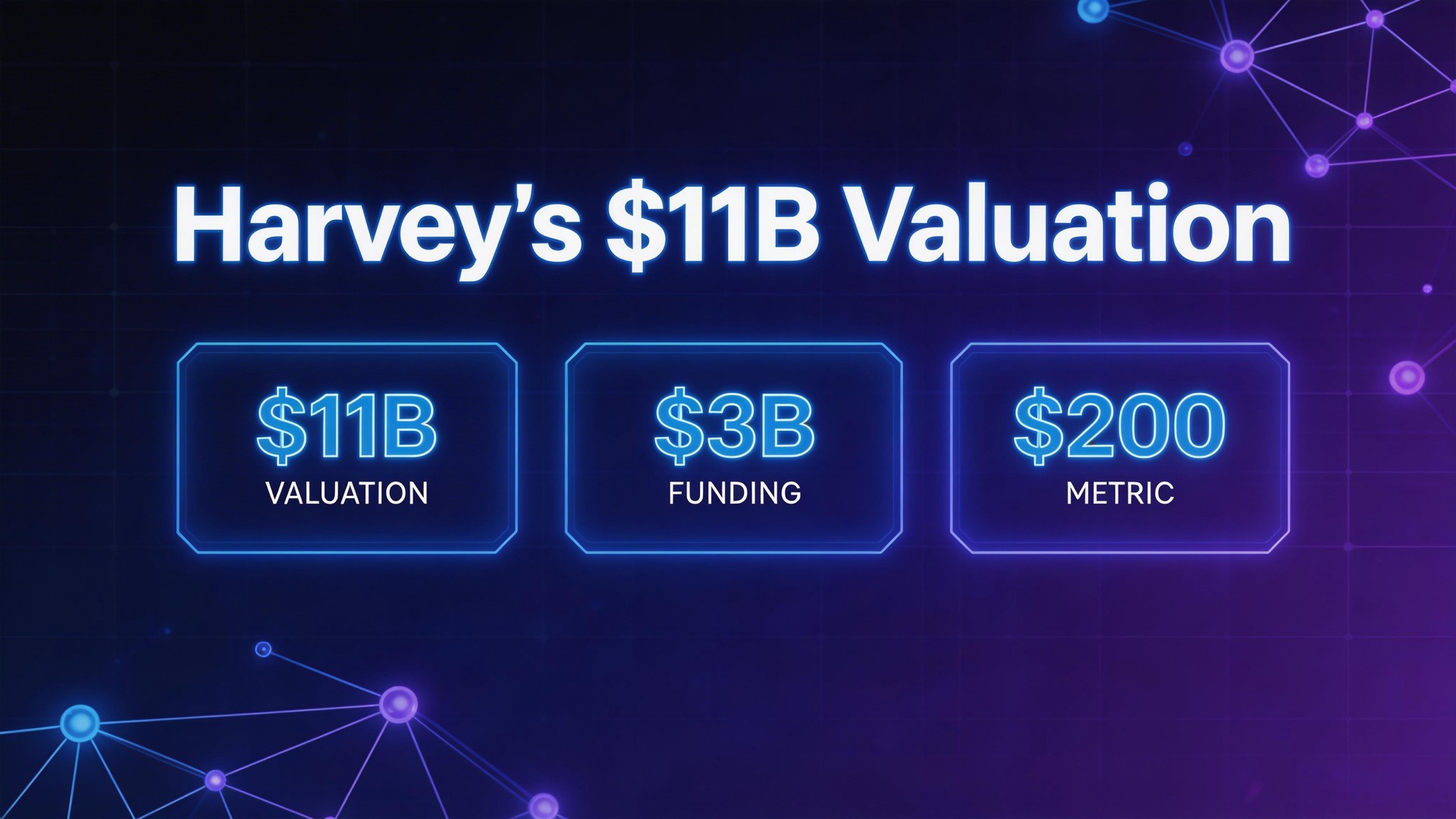
From $3B to $11B in under a year—Harvey’s trajectory reveals what happens when enterprise AI actually delivers measurable value.
The Core Insight
Legal AI startup Harvey is reportedly in talks to raise $200 million at an $11 billion valuation, led by Sequoia and Singapore’s GIC. If completed, this would mark a $3 billion valuation increase in just a few months, following December’s $8 billion round led by Andreessen Horowitz.
The velocity of capital deployment tells one story. The revenue numbers tell another: Harvey hit $190 million in annual recurring revenue by end of 2025, nearly doubling from $100 million in August. In enterprise software, that growth rate while maintaining quality is exceptionally difficult to achieve.
The funding history maps the acceleration:
– February 2025: $300M Series D at $3B (Sequoia)
– June 2025: $300M Series E at $5B (Kleiner Perkins, Coatue)
– October 2025: $160M at $8B (Andreessen Horowitz)
– February 2026: Potentially $200M at $11B (Sequoia, GIC)
Four funding rounds in twelve months, with each round attracting top-tier investors who are historically disciplined about valuations.
Why This Matters
Harvey’s trajectory matters beyond the headline numbers for several reasons:
Product-Market Fit in Practice: Legal services represent an ideal AI application domain. Documents are central to the work. Language patterns are relatively structured. The cost of human expertise is extremely high. Harvey found a vertical where LLM capabilities directly translate to measurable efficiency gains.
Revenue Quality: When founder CEO Winston Weinberg reports ARR, he’s describing contracted, recurring revenue from law firms and legal departments. This isn’t API consumption that might churn; it’s enterprise contracts with institutional clients who have integrated Harvey into their workflows.
The Talent Density Hypothesis: Harvey’s founding story—a first-year legal associate building one of Silicon Valley’s hottest startups—challenges the assumption that domain expertise requires decades of experience. Sometimes it requires recent exposure to pain points plus technical capability to address them.
Valuation as Competitive Moat: At $11 billion, Harvey has war chest capacity that makes competitive entry extremely difficult. They can acquire complementary technologies, retain top talent, and subsidize enterprise deals to lock in clients.
Key Takeaways
- Potential $11B valuation, up from $8B in December 2025
- ARR grew from ~$100M to $190M in under six months
- Four major funding rounds in twelve months
- Investor roster includes Sequoia, a16z, Kleiner Perkins, Coatue, and GIC
- Enterprise legal AI proving to be one of the highest-traction AI application categories
- First-mover advantage compounding with each funding round
Looking Ahead
Harvey’s trajectory raises the stakes for every other vertical AI play. The question isn’t just “can AI work in [industry X]”—it’s “can you achieve Harvey-level product-market fit and growth before better-funded competitors arrive?”
For legal professionals, the message is clear: AI tools are no longer experimental. Firms using Harvey are achieving efficiency gains that non-users can’t match. The technology adoption curve is compressing.
For AI entrepreneurs, Harvey demonstrates both the opportunity and the challenge. The opportunity: verticals with high labor costs and document-centric workflows are ripe for disruption. The challenge: first-movers with strong execution can build moats quickly enough to make later entry extremely difficult.
Based on analysis of “Harvey reportedly raising at $11B valuation just months after it hit $8B” from TechCrunch